

Air sickness is less common than car or boat sickness, but it affects roughly 10–15% of passengers during turbulent flights. The right seat and the right strategy make a significant difference.
Most people can fly without motion sickness on smooth flights. Turbulence changes the calculation. The unpredictable vertical and lateral motion of a plane in turbulent air creates the same sensory conflict that drives car and boat sickness: your vestibular system feels the motion, your visual system (focused on the interior of the plane) doesn't confirm it.
The good news: airplane motion sickness is generally milder than car or boat sickness, it's manageable with relatively simple strategies, and the single most important decision, seat selection, can be made before you even pack.
Section 1: Why airplanes trigger motion sickness
On smooth flights at cruising altitude, airplanes generate very little sensory conflict. The plane moves steadily forward, the cabin provides a stable visual environment, and many passengers experience no vestibular challenge at all.
Turbulence changes everything. Moderate turbulence creates unpredictable vertical "bump" motion, occasionally lateral shaking, and sudden brief changes in apparent gravity. These inputs are precisely the type that generate sensory conflict: the vestibular system registers them clearly, but the visual system, looking at a stationary seat back, an overhead bin, or a screen, doesn't confirm them.
Why some people are affected and others aren't
Motion sickness susceptibility varies substantially between individuals. People with stronger visuospatial processing tend to resolve sensory conflict faster and with less nausea. People who are generally susceptible to car or boat sickness tend to also be susceptible to air sickness, though often less severely (because the aircraft's motion is smoother than winding roads or small boats).
Anxiety about flying is a distinct but overlapping factor. Some people experience anticipatory nausea, feeling sick before any actual turbulence, driven by anxiety about flying. This is psychosomatic in origin but physiologically real. It can look like and feel like motion sickness even when the plane hasn't moved noticeably.
Section 2: The best seats for motion sickness
Seat selection is the highest-impact preventable variable for air sickness.
Over the wings: the most stable location
The wings are roughly the center of mass and lift of the aircraft. Seats in the wing section experience the least motion during turbulence, because turbulence creates a rotating motion around the center of the aircraft: the further you are from the center, the more you move.
For most commercial aircraft:
- Narrow-body jets (737, A320 family): Rows 14–20 approximately
- Wide-body jets (777, A380, 787): Rows 30–45 approximately (varies by aircraft)
Check the specific aircraft layout on SeatGuru or the airline's seat map. Look for where the wings are and book as close to that center section as possible.
Window seat advantage
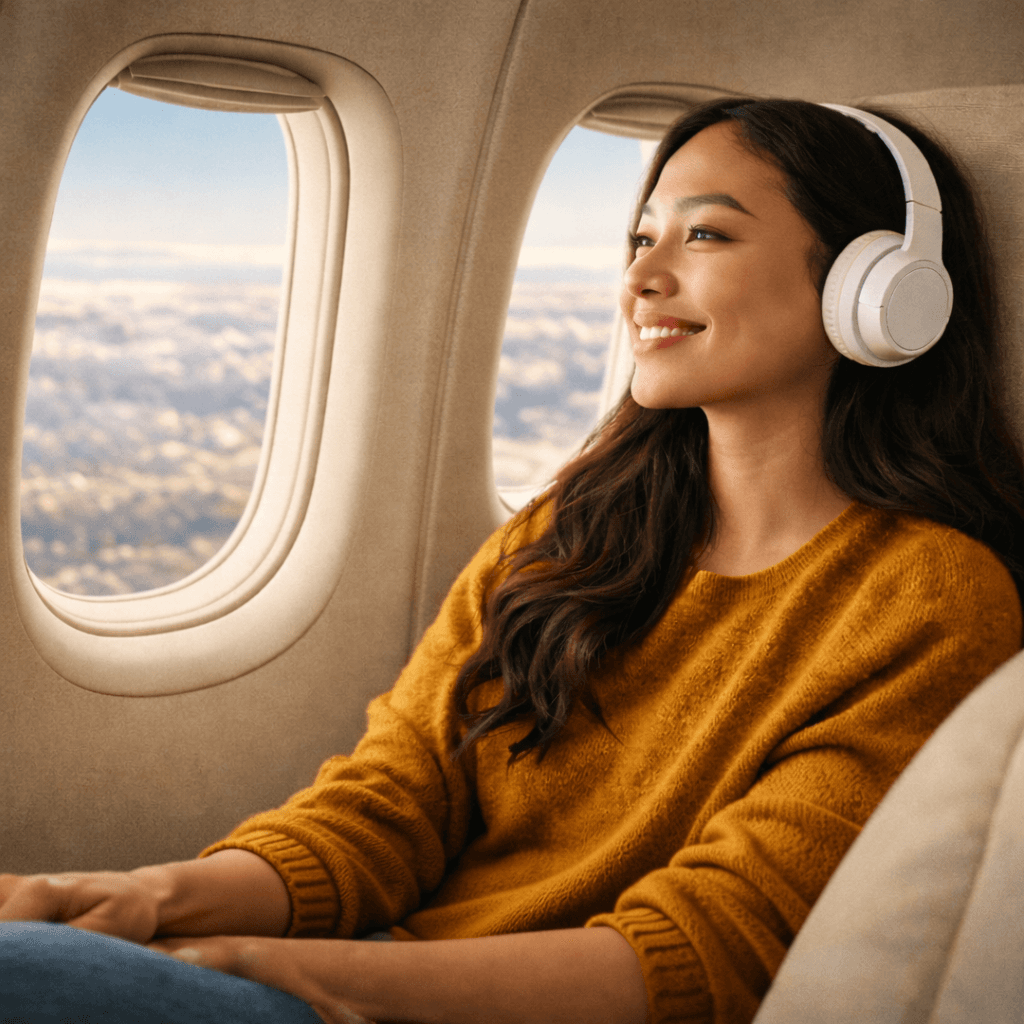
Window seats allow visual access to the horizon and the ground, providing real visual information about the direction of motion. Looking out the window at the horizon during turbulence is the most effective non-pharmacological strategy available in-flight. Aisle seats and middle seats lose this option entirely.
The horizon view out an airplane window is partially obscured by clouds much of the time, but even intermittent access is better than none. During smooth conditions, the visual reference helps calibrate the vestibular system for the turbulent sections.
Avoid the rear
The back of the aircraft experiences more motion than the front during turbulence, because the plane tends to pivot around a point closer to the nose and center of lift. Back row seats (often popular for extra recline) are the worst option for susceptible passengers.
Section 3: In-flight strategies
Once you're on board, several strategies can reduce symptoms or prevent them from escalating.
Focus on the horizon when turbulence hits
At the first sign of turbulence, look out the window at the horizon or the ground. If you're not in a window seat and turbulence is significant, ask to switch or move to a jump seat near a door window (flight attendant permission required). The horizon is your most effective stabilizing visual reference.
Use the air vent
The air vent above your seat, directed at your face, provides cool fresh air that reliably reduces nausea severity for many people. Stuffiness and warmth lower the threshold for symptoms. Keep the vent open and directed toward you throughout the flight.
Avoid large meals before and during turbulent sections
A light meal 1–2 hours before departure is better than an empty stomach. Avoid rich, heavy, or strongly scented in-flight meals during turbulent portions of the journey. Ginger gum or ginger candies are worth having in your carry-on.
Recline your seat
Some people find reclined positions slightly more comfortable during turbulence. The hypothesis is that the reclined position changes the vestibular input geometry slightly, reducing the mismatch. It's not a dramatic intervention, but it's a free one.
Medication timing
Dimenhydrinate (Dramamine) and meclizine (Bonine) must be taken 30–60 minutes before turbulence to be effective. For domestic or regional flights where turbulence is difficult to predict, taking medication with breakfast or at airport check-in provides coverage. For long-haul international flights, the scopolamine patch (prescription) provides continuous coverage without repeated dosing.
Section 4: When anxiety is the bigger issue
A meaningful subset of air sickness sufferers are primarily experiencing anxiety-driven nausea rather than pure sensory conflict motion sickness. The distinction matters because the treatment differs.
Signs that anxiety is the primary factor:
- Nausea begins at the airport or during boarding, before any motion
- Smooth flights with no turbulence still produce significant nausea
- Thoughts about flying (not the actual motion) appear to trigger symptoms
- Heart rate and breathing changes accompany nausea
For anxiety-driven air sickness, the most effective interventions are cognitive behavioral techniques, breathing exercises, and sometimes anti-anxiety medication, not anti-nausea or anti-motion medication. If you recognize this pattern in yourself, addressing the anxiety directly (rather than primarily treating the nausea) will produce better results.
Many people have a combination of both. Motion sickness medication can handle the physiological component while anxiety management techniques address the anticipatory component.
Section 5: Pre-flight brain training
For frequent flyers who experience consistent turbulence nausea, pre-flight brain training offers a longer-term solution.
The same visuospatial exercises shown to reduce motion sickness susceptibility by 51–58% in the University of Warwick study are relevant for air sickness, as the underlying mechanism is identical. Two weeks of 15-minute daily exercises, begun at least two weeks before a trip you're concerned about, meaningfully reduces susceptibility.
For the full protocol, see the complete brain training guide. For broader travel motion sickness strategies across all modes, see the complete travel motion sickness guide and top 10 travel tips for motion sickness.
If you take something before a flight and land too foggy to drive the rental car, that trade-off is worth understanding: why motion sickness medication makes you drowsy explains the pharmacology and the non-sedating alternatives. Our complete remedies guide compares every option in one place.
Air sickness is a context where the anxiety factor often goes unaddressed because people (and sometimes doctors) assume it's all about the motion. But I've seen people who've done everything right (wing seat, window, Dramamine, no food) and still felt sick from the moment they walked through the jet bridge.
For those people, the missing piece is almost always the anxiety component. Once they address that, typically through breathing techniques and gradual exposure to the airport and boarding environment without immediately flying, the remaining motion sickness component becomes much more manageable.
Find Out What's Causing Your Motion Sickness
Take our free 2-minute assessment to get a personalized motion sickness profile — and a science-backed plan to reduce your symptoms.
The bottom line
Airplane motion sickness is primarily a turbulence problem. The right seat (over the wings, window) and the right strategies (horizon gaze, air vent, medication timing) address most of the situational challenge. If anxiety is a co-factor, it needs to be addressed separately.
For frequent flyers with consistent air sickness, pre-flight brain training is the most effective path to lasting improvement.
This article is part of the Motion Sickness While Traveling guide.
Sources
- Reason JT, Brand JJ. Motion Sickness. Academic Press, 1975.
- Golding JF. "Motion sickness susceptibility." Autonomic Neuroscience. 2006;129(1-2):67–76.
- Smyth J, et al. "Visuospatial training reduces motion sickness susceptibility in healthy adults." Experimental Brain Research. 2021;239(4):1097–1113.
- Lackner JR, DiZio P. "Space motion sickness." Experimental Brain Research. 2006;175(3):377–399.
Discover What's Really Behind Your Motion Sickness
Our free assessment identifies your motion sickness type and susceptibility level — then gives you a personalized plan based on your results.
Know your motion sickness triggers and severity
Get a personalized symptom reduction plan
See which training exercises match your profile
Free — takes less than 2 minutes